Roster construction is possibly the most common starting point for best ball strategy discussion. Most people seem to agree that the best approach for baseball is to draft 6-8 players per position, an idea based largely on data from previous Dinger results. However, sicne the Dinger is a relatively new contest, we are working with limited data. Ideally, we would also like to have some math on our side.
Sackrelgious from Legendary Upside popularized the concept of “number of unique starting lineups”, or the total number of possible unique eligible lineups (i.e. 3P – 3 IF – 3OF – 1Flex) we can make from any given roster of 20 players. He elaborated on this concept in his LegUp article Way Too Early Best Ball Draft Strategy (paywall).
Since Sack’s article specifically runs through unique combinations for a football starting lineup, which has different positional requirements than baseball, I decided to rerun the math for baseball rosters.
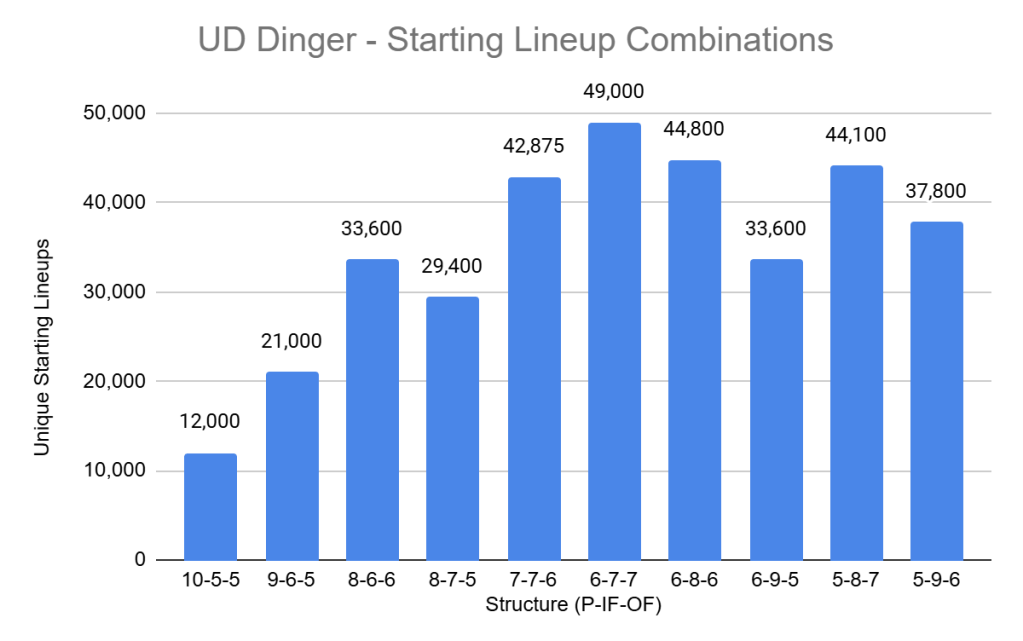
One quick note, flipping the IF and OF values results in the same number of unique starting lineups. For example, both a 6-8-6 and 6-6-8 structure would result in 44,80 unique starting lineups.
With a fully healthy roster, a 6-7-7 structure provides the maximum number of unique starting lineups. Additionally, 7-7-6, 6-8-6 (or 6-6-8), and 5-8-7 (or 5-7-8) are the next best options.
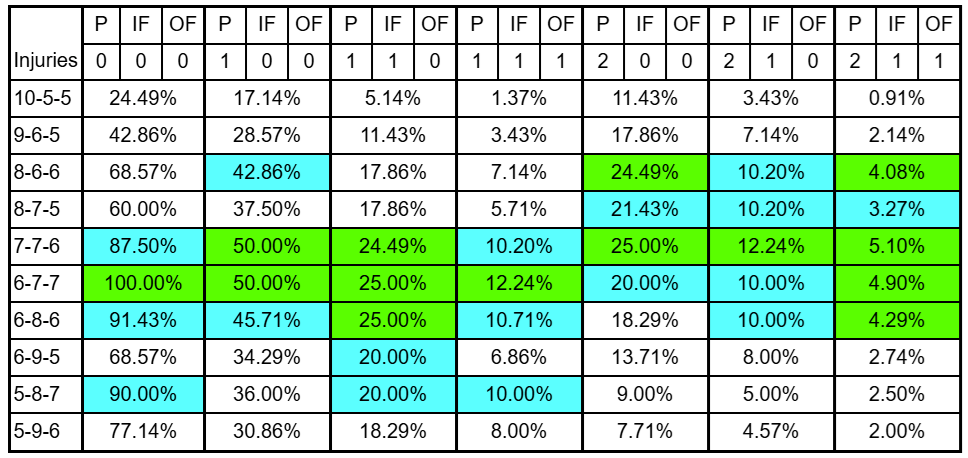
However, the math starts to change once injuries start to hit. I reran each structure with various injury scenarios, and then divided the result by 49,000 (the most possible lineups, a fully healthy 6-7-7 roster). For each injury scenario, I highlgihted the best structures in green, and reasonably close structures in blue.
Some key takeaways:
- Do not draft too many pitchers.
- Drafting an 8-6-6 structre can be okay, as it does protect a little against pitcher injuries without sacrificing too much offense.
- However fully healthy rosters (if those are possible) with fewer pitchers would have a huge lineup edge.
- My first year of mlb best ball, I primarily targeted 10-5-5 builds. My advance rates were awful. This chart helps illustrate why those teams performed so terribly.
- The most common structures are probably the best structures.
- The structures that provide the most unique lineup combinations with a fully healthy roster continue to look good even when they rack up injuries.
- I will probably plan to target 6-7 P, 7-8 IF, and 6-7 OF in every draft. That strategy should provide enough flexibility to target the best players in each round wihtout having to force inferior picks to statisfy a rigid structure requirement.
- I will probably mix in some 5-8-7 builds.
- Pitcher injuries could take a toll quickly.
- May not get enough two-start weeks in the postseason to advance and contend in the finals.
- However if all 5 pitchers stay healthy and “hit”, these lineups should provide enough offensive firepower to dominate the flex.
 makerpm